← All work
MVP Strategy Field Research Market Segmentation Validation

Turning lab-stage water tech into a testable MVP direction.

A technology in search of a market — narrowed to its strongest first-adopter context and handed to the founder as a bet they could actually test.

Role
Product Design Consultant / User Researcher
Timeline
~16 weeks
Team
Two researchers, a product designer & a senior product design director, with the client CEO
Project Type
0→1 product discovery, user research & rapid prototyping
The Problem

A promising technology with no clear product

Aquamox had built something novel: a way to turn ordinary water into an environmentally friendly sanitizer. The capability was real — but the product wasn't. No one knew who it should serve, where it fit, or what would make people use it.

The brief was to find the pain points and market gaps, then shape a concept for validation. The obvious starting point was the technology: it sanitizes better, so who wants better sanitation?

But "better" isn't why people adopt things — and that gap became the project.

The Reframe

People already have cleaning routines, trusted products, and workarounds around hygiene. A new product doesn't win by being technically better — it wins by fitting behavior people already have, or earning trust where the value is invisible. The question wasn't whether the tech worked. It was where it would be believed.

Who wants better water sanitation?
THE REAL QUESTION ↓
Where would people trust this technology enough to actually use it — and change their routine for it?
My Role

Across the full arc, research to validation

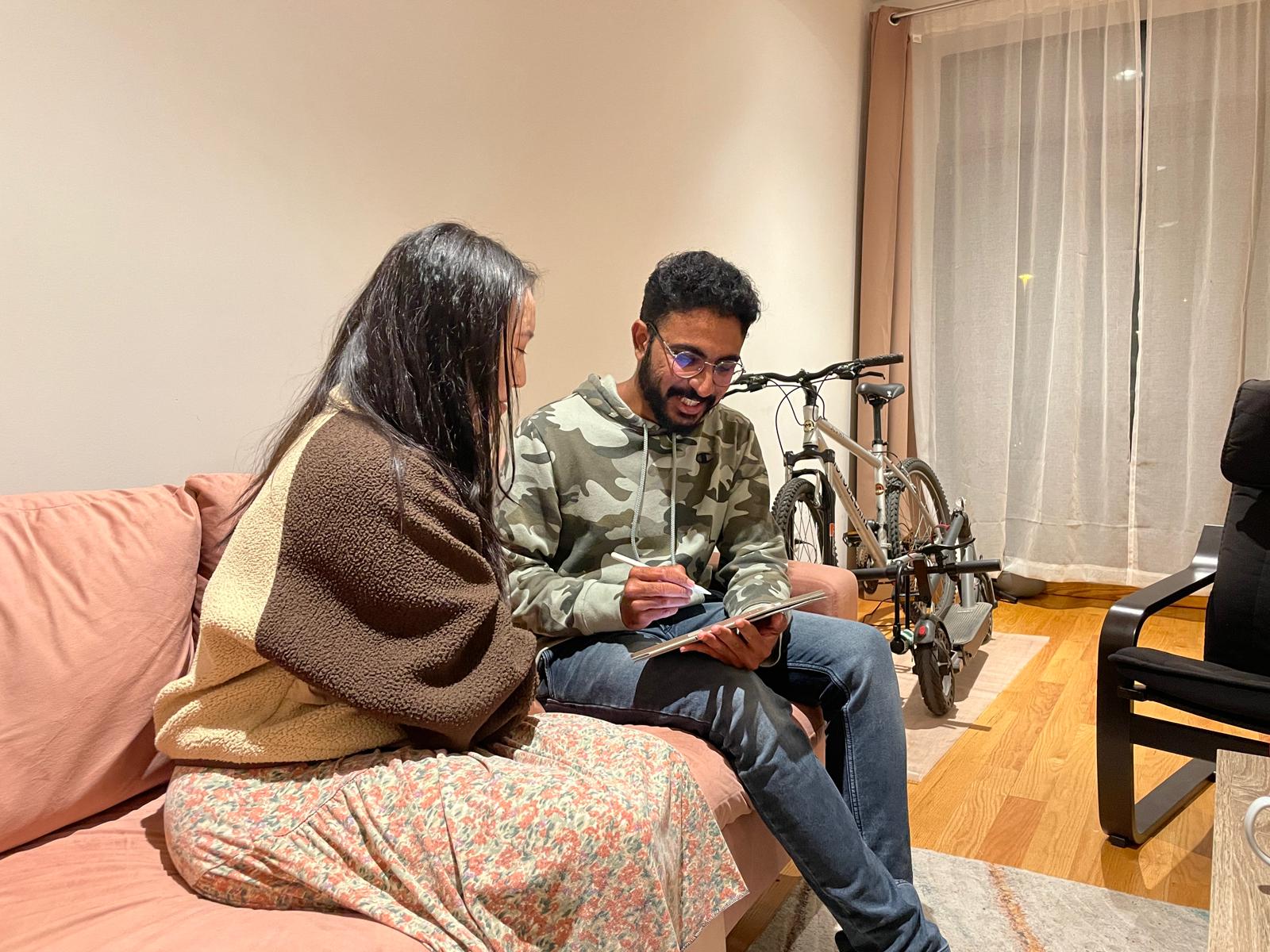
On a team of three working with the client CEO, my contribution ran end to end. I led market research, recruited participants, and ran the field interviews and in-home observations, then synthesized findings into the frameworks that shaped the direction.

On delivery, I built the prototypes and wireframes, and developed the Business Model Canvas and validation-metrics framework the founder would use to test the concept.
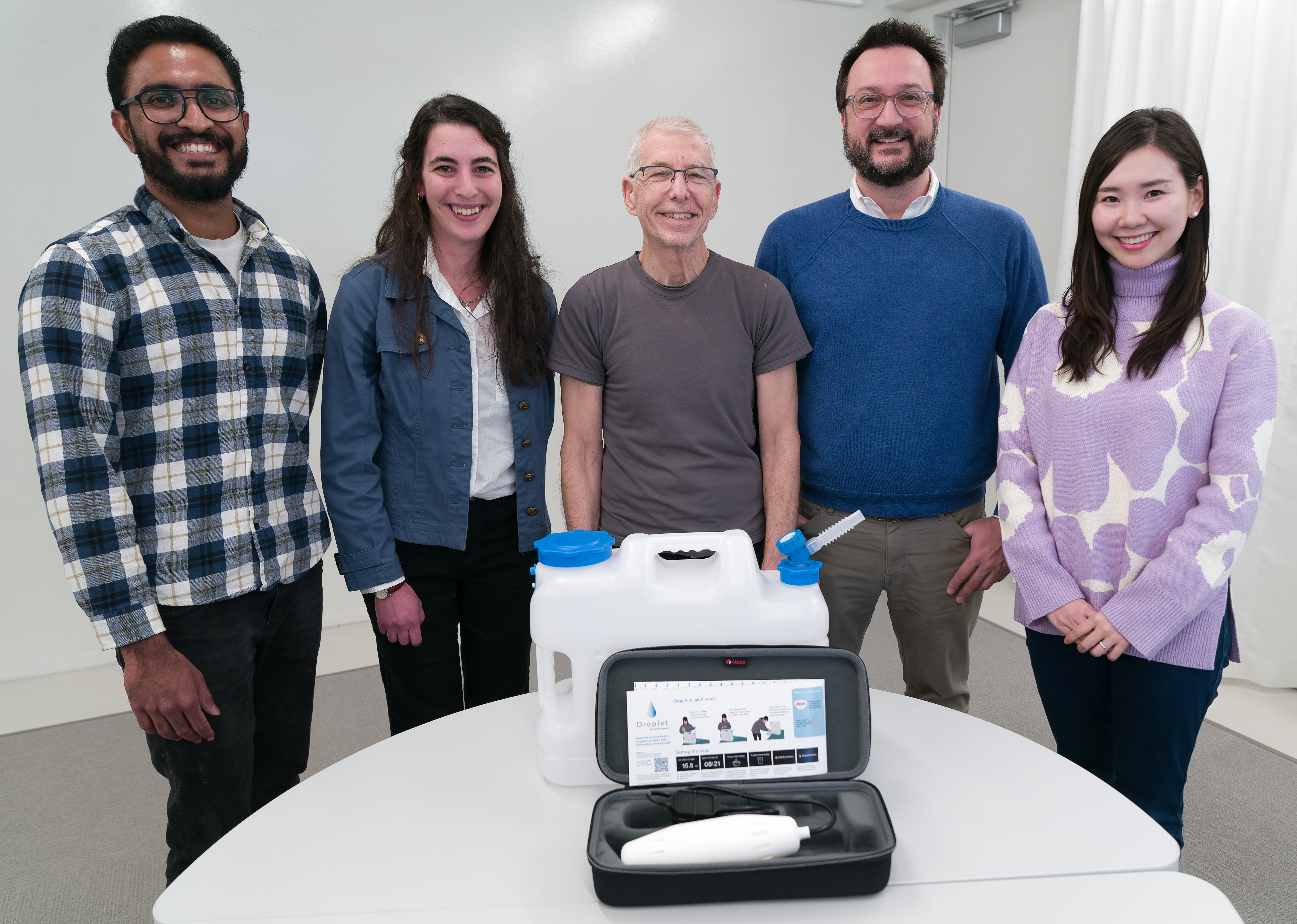
Final team presentation with the Aquamox CEO
Final team presentation with the CEO of Aquamox.
The Research

Finding where the technology had a real job

I ran field studies where people actually manage hygiene — separating what the technology could do from where it had the strongest pull.

Secondary market research In-home field studies User interviews Jobs-to-Be-Done Journey mapping

The studies made the adoption problem concrete by contrasting two candidate contexts:

Kitchens — weak pull

Users already had trusted routines. A new step needed an obvious payoff, and "cleaner" alone wasn't enough to change behavior.

Outdoors — strong pull

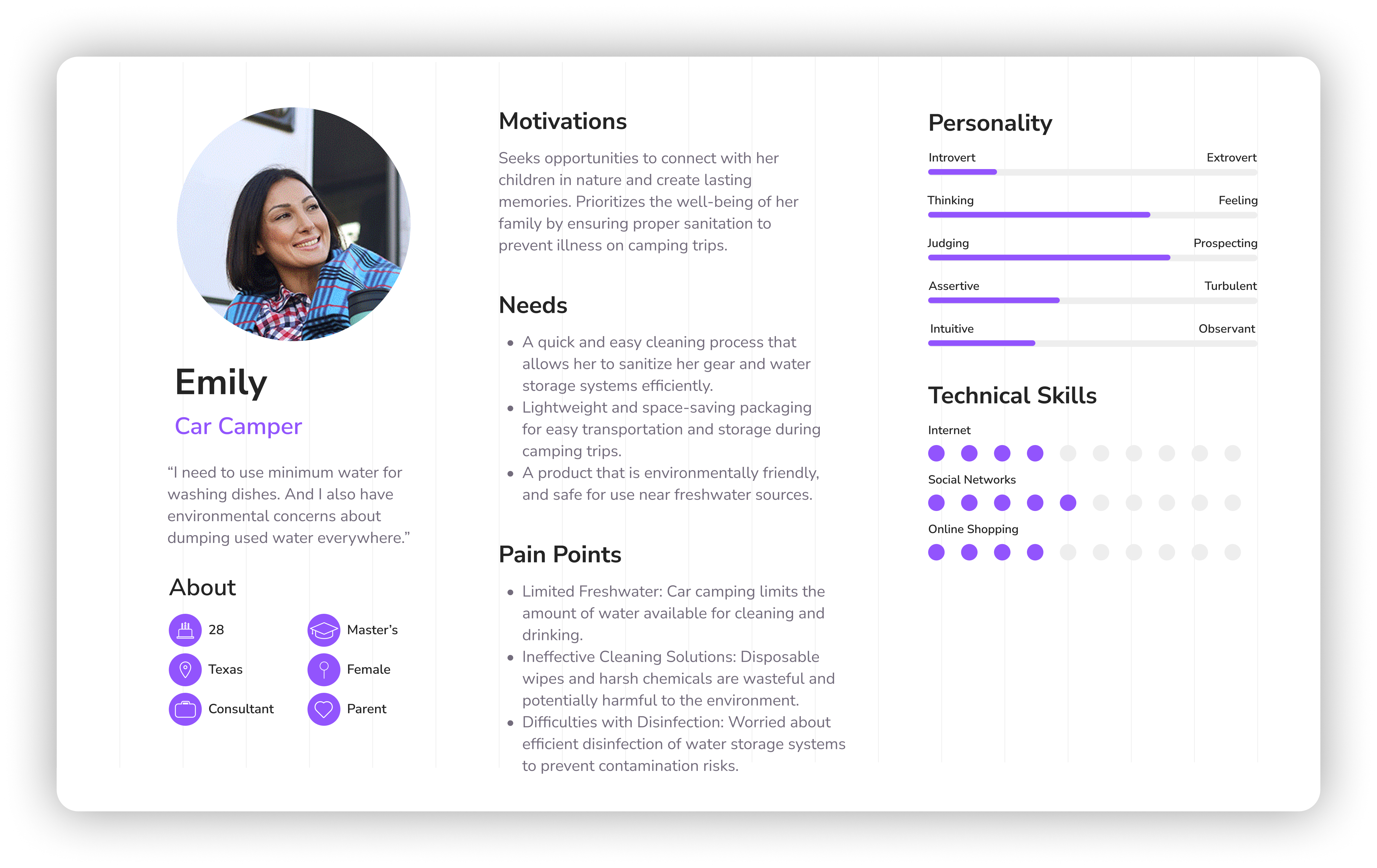
Campers and RV users were already managing water limits, storage, and waste — so the technology solved a problem they felt daily.

The Decision

Follow the strongest adoption logic

The core call

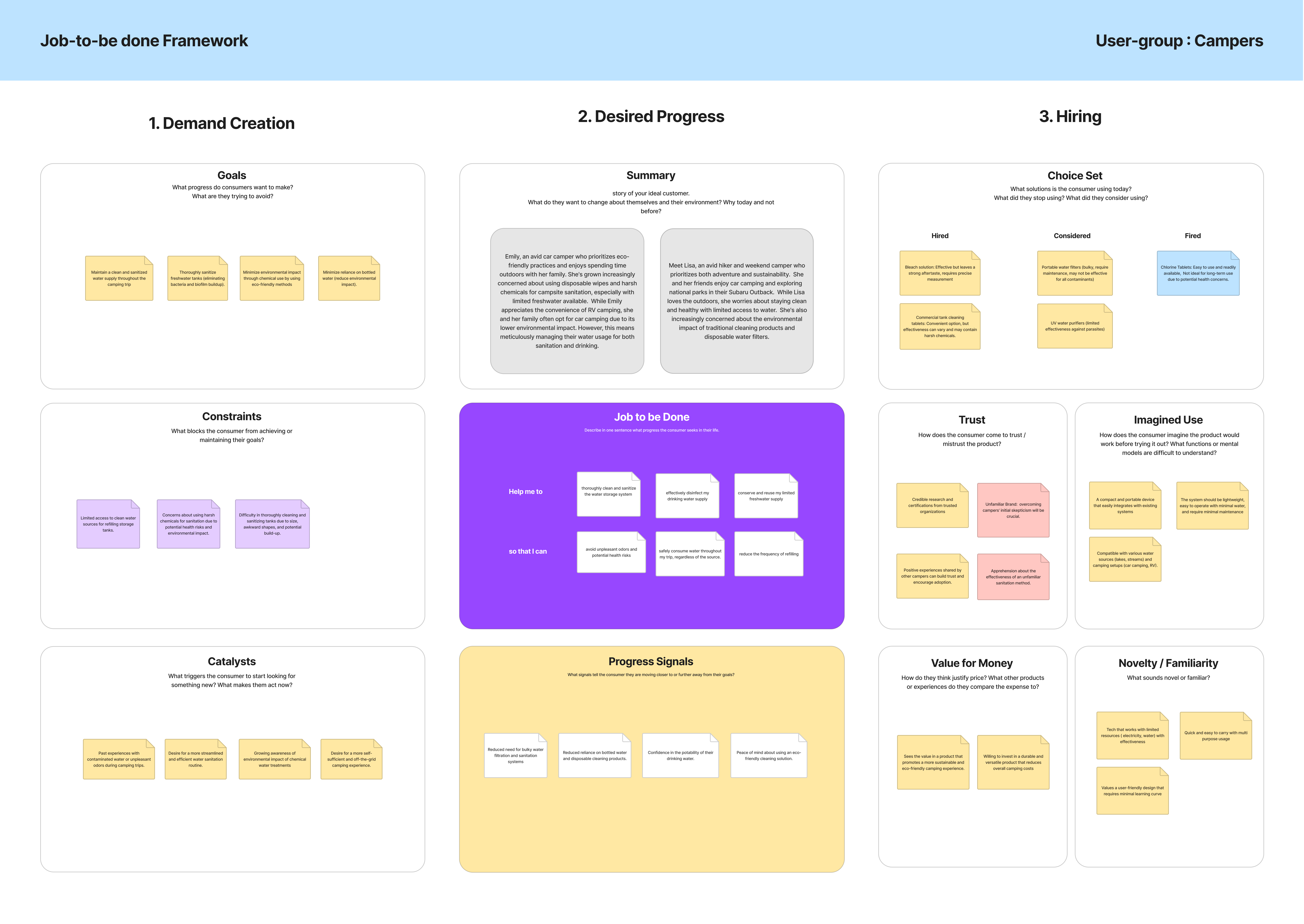
Jobs-to-be-done analysis and an adoption-feasibility matrix made the comparison concrete: the outdoor context had a stronger job, clearer constraints, and better validation potential than the kitchen, where entrenched routines made behavior change hard.

So I recommended narrowing MVP focus to campers and RV users — choosing the context we could actually validate over the broader, more familiar kitchen market. A segment you can win beats a bigger one you can only theorize about.

Jobs-to-Be-Done analysis

Before committing to a form, I pressure-tested the direction with a 60-minute workshop with three campers — card-sorting their values, existing "haves," and adoption barriers, then prioritizing must-haves. Clarifying who before what kept us from jumping straight to a prototype.

The MVP Direction

Droplet, built to be tested

The direction had to make the idea tangible while keeping its assumptions honest — each piece built to be questioned, not admired.

01 — The concept

Portable sanitation for off-grid life

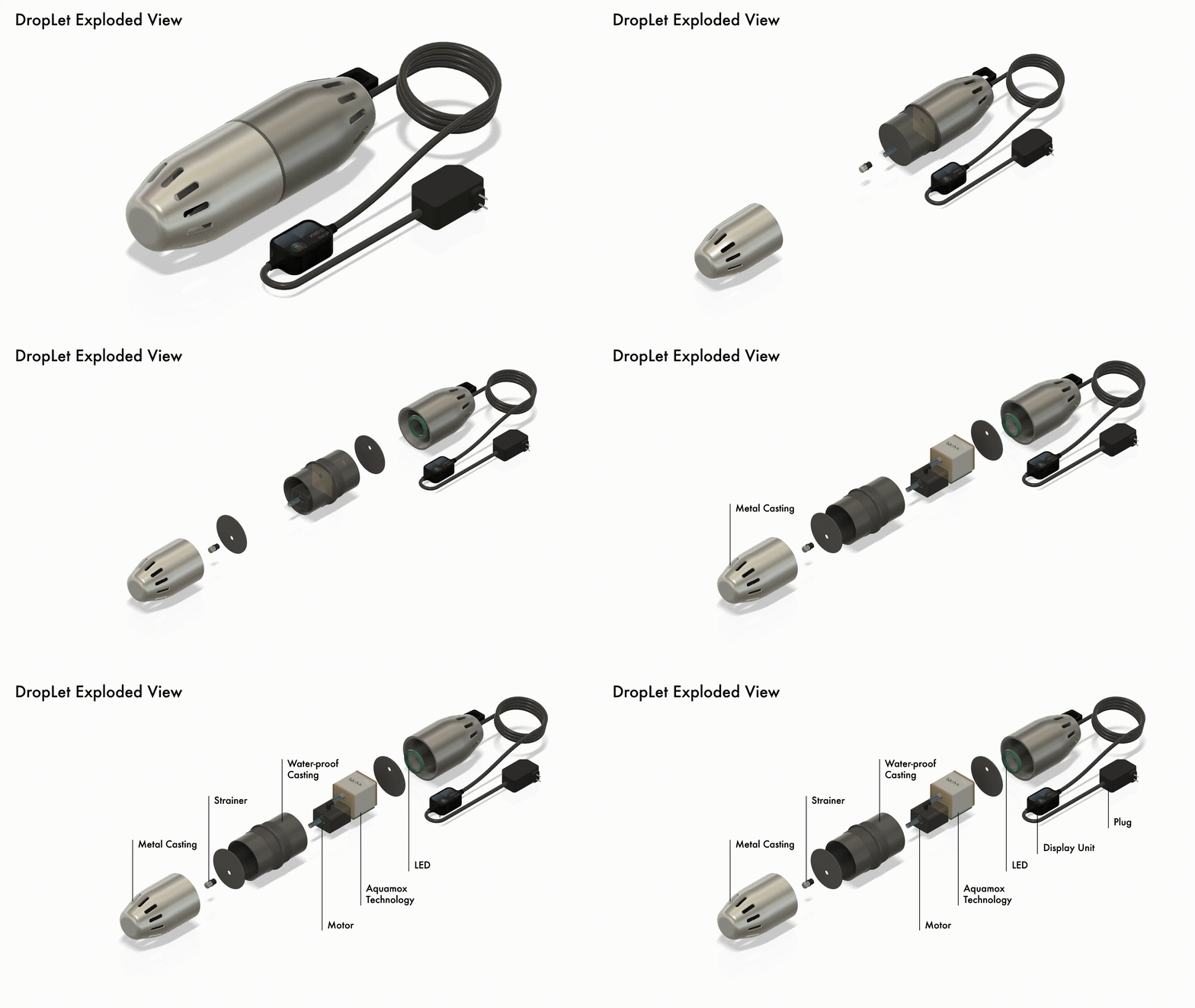
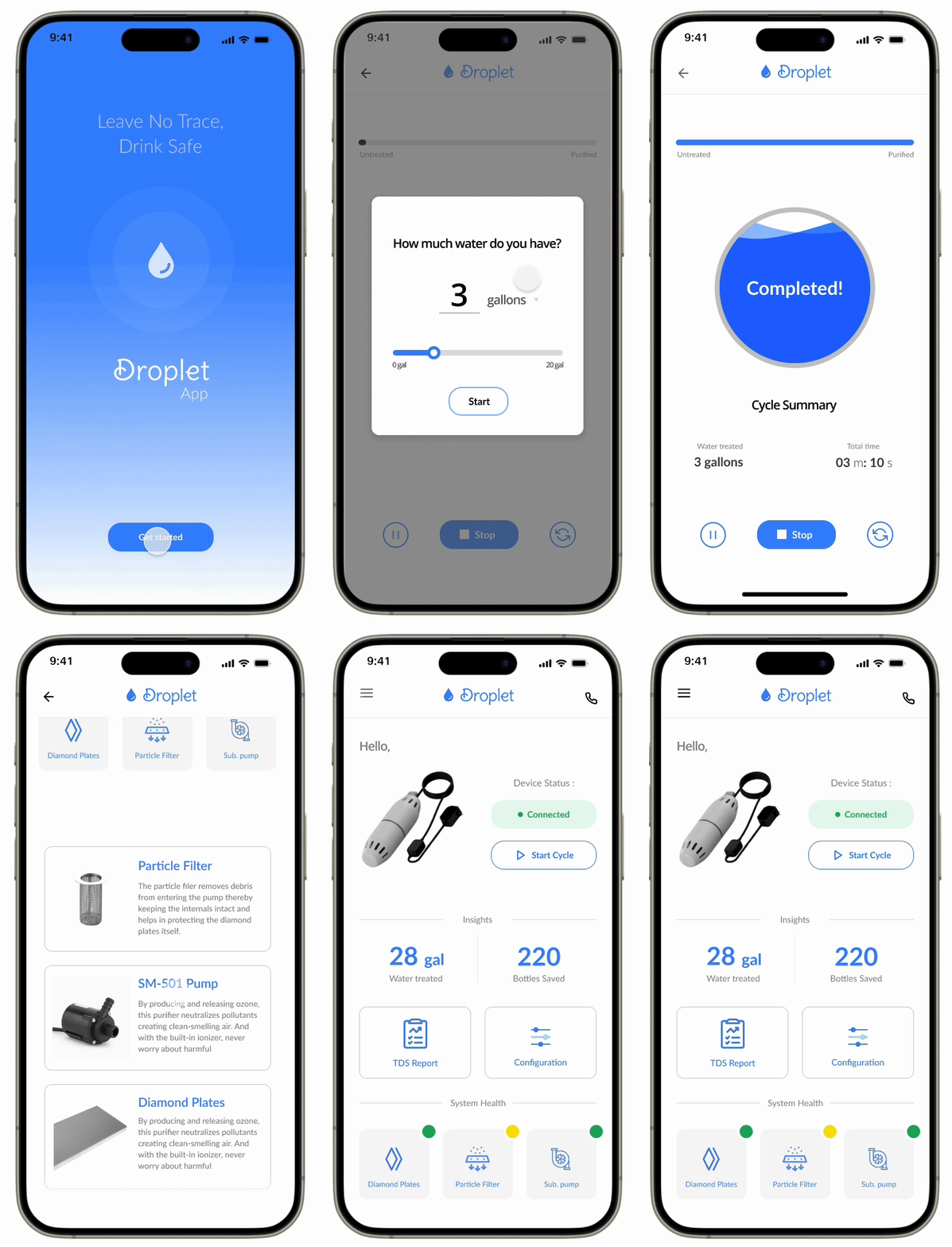
I shaped Droplet around a truth the research surfaced: campers and RV users already think about water, storage, waste, and low-impact living. It fit that existing mindset instead of asking for a new one — delivered as physical form studies and digital wireframes.

Physical prototype
Digital wireframes
02 — Testing the concept

Prototypes as questions, not proof

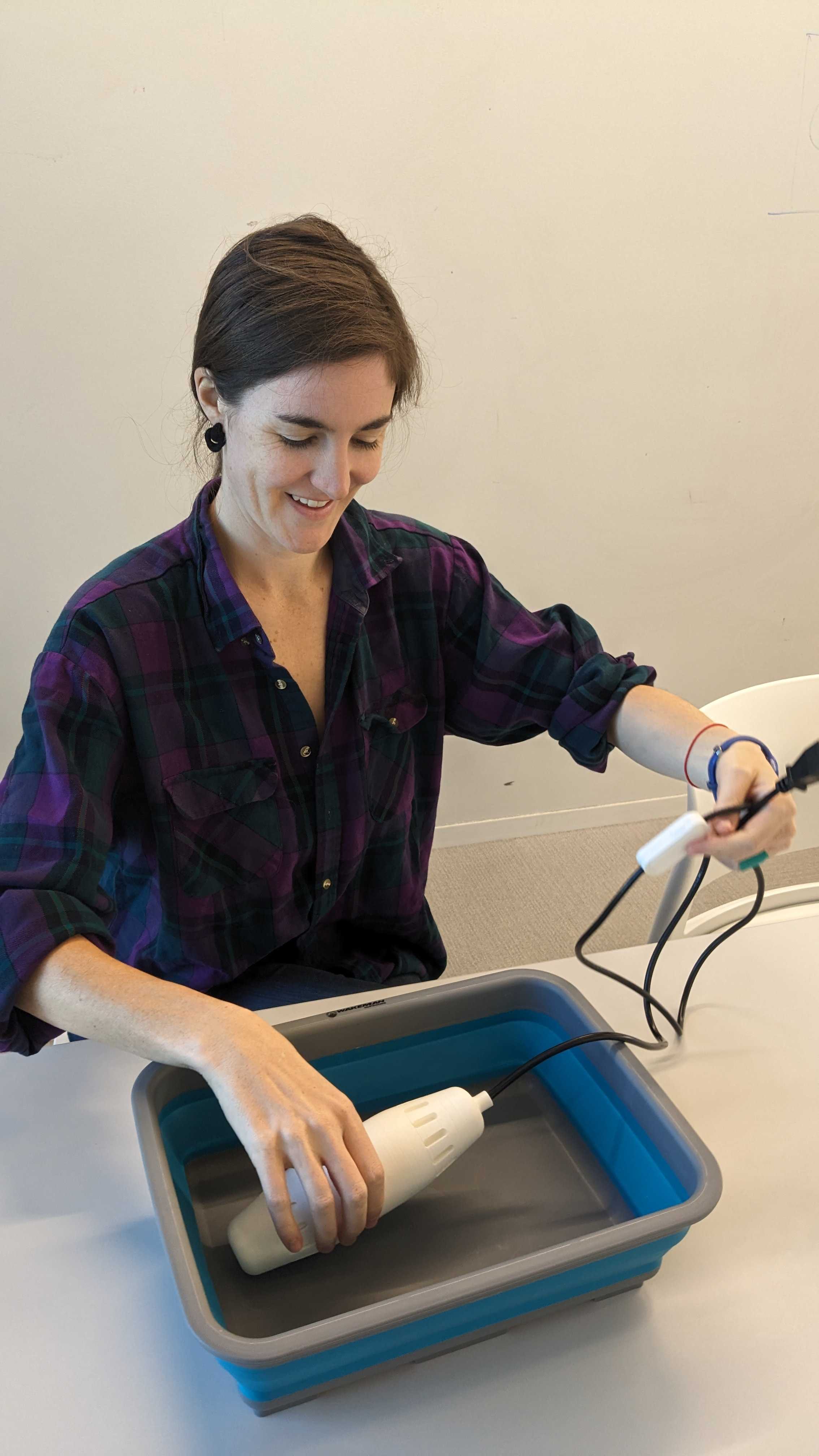
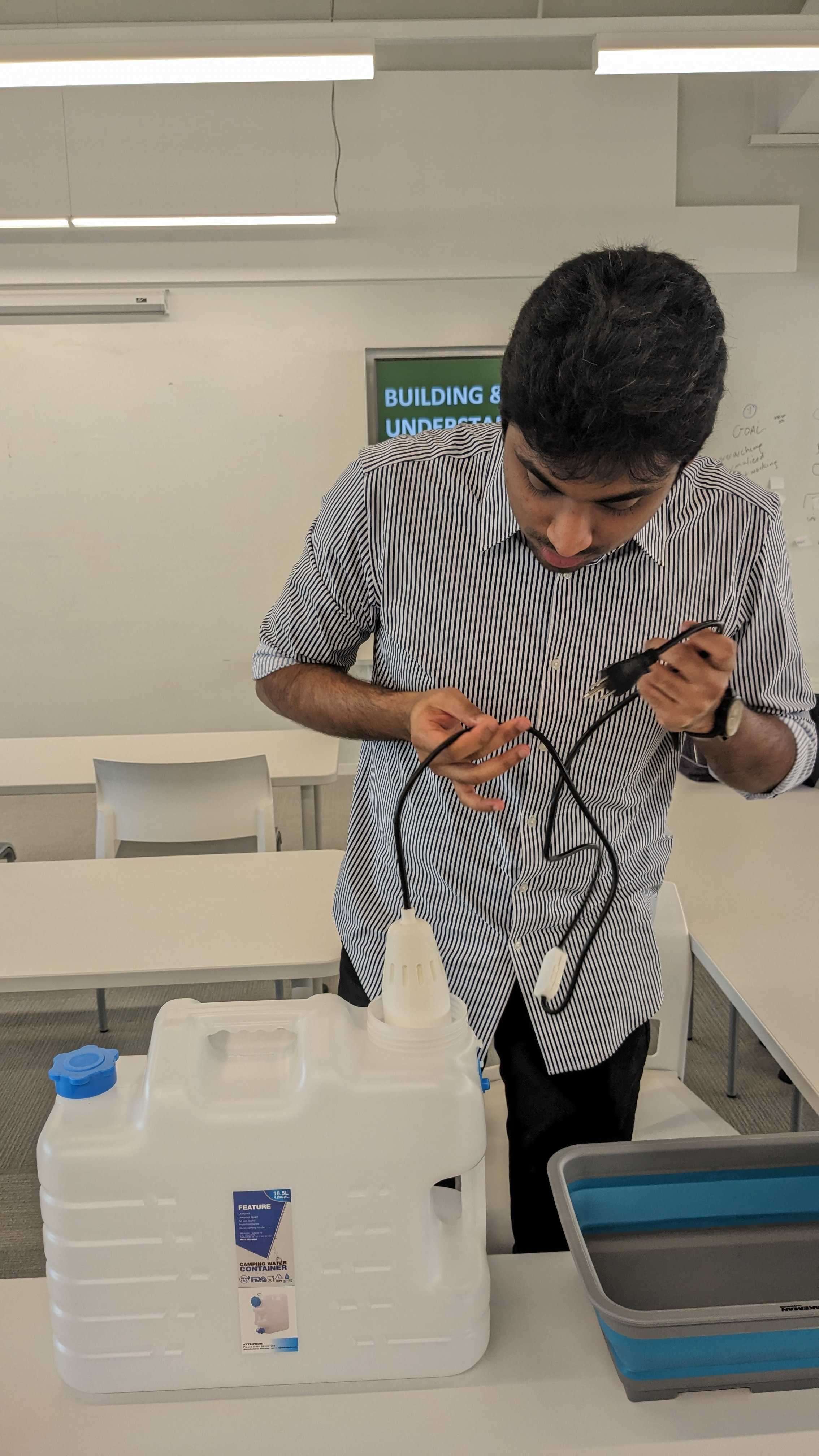
The 3D-printed forms weren't meant to look final — they were made to be questioned. I put them in front of campers to test whether the concept fit their context, using the prototype to surface doubts and refine direction.

Prototype testing
Prototype testing with campers
03 — The validation framework

Criteria the founder could invest against

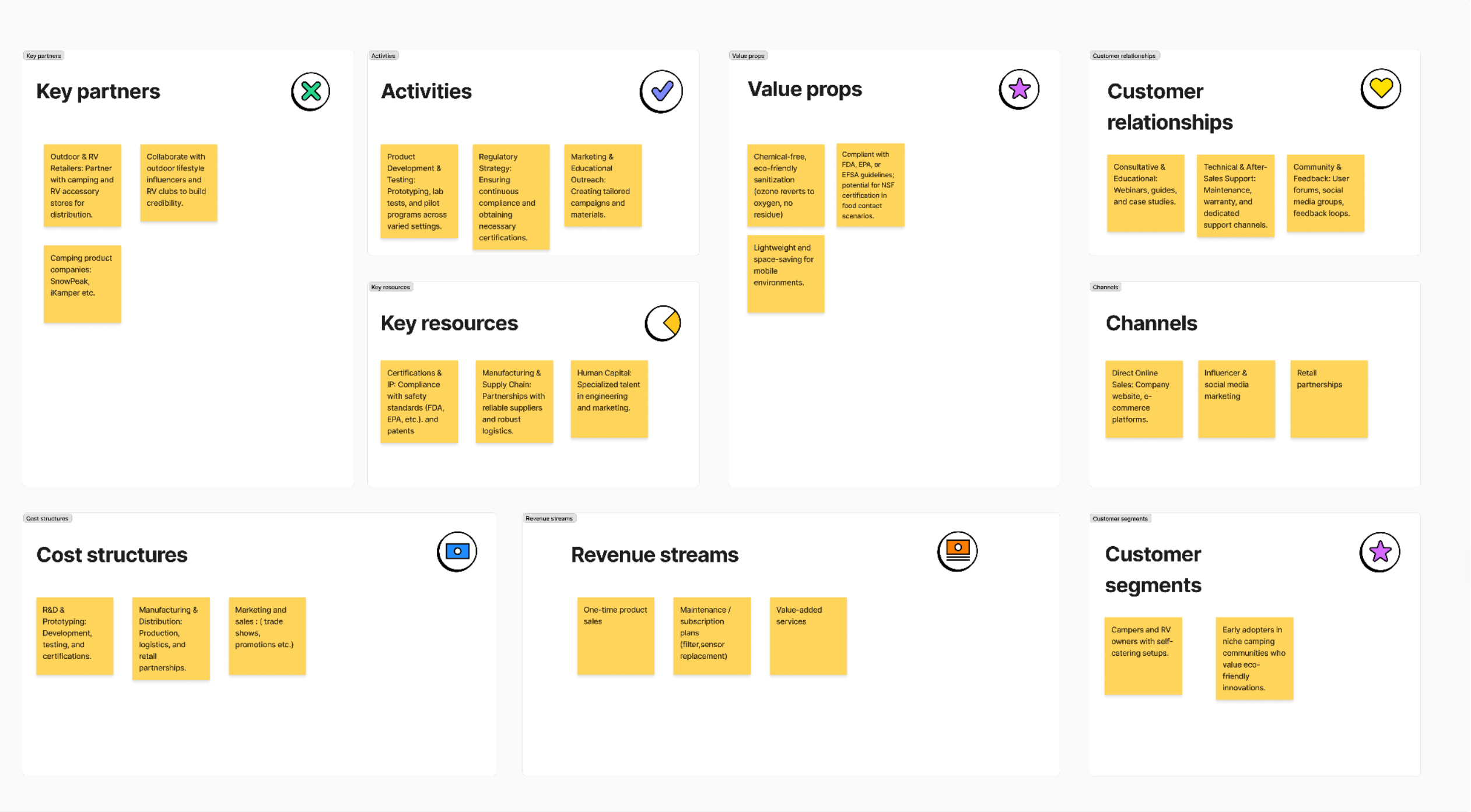
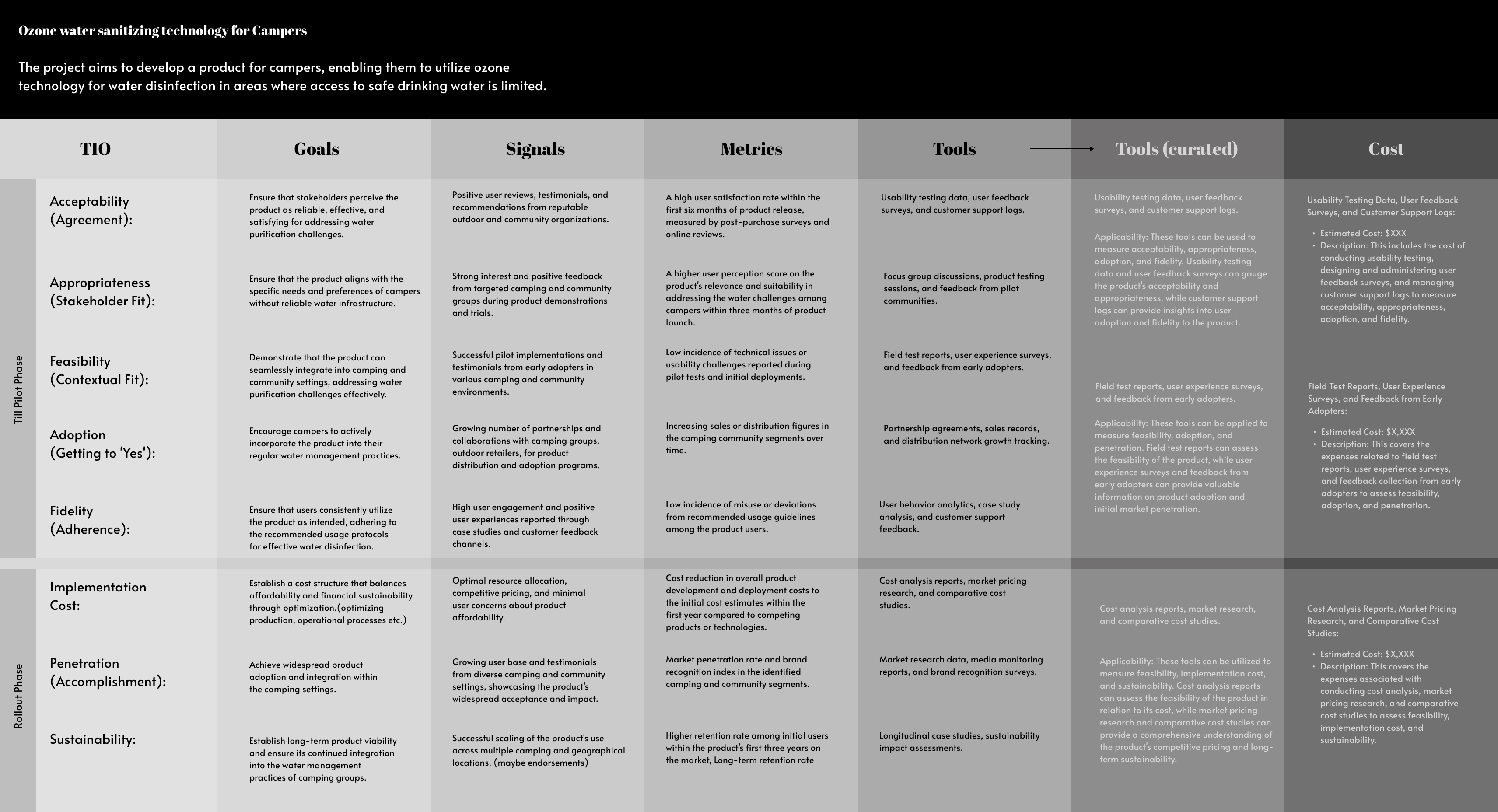
I built a Business Model Canvas to surface the assumptions behind the concept — value proposition, segment, channel, retention — and a modified Proctor's Implementation Outcomes framework to define what adoption evidence would count: is ozone tech acceptable, does it fit the camping context, will users adopt it into routine rather than try once, does the cost math work at scale?

It shifted the question from "does the prototype work?" to "what would we need to see to know this is worth building?" — criteria instead of enthusiasm.

Business Model Canvas
Business Model Canvas — mapping the assumptions behind the concept.
TIO validation metrics
Modified Proctor's TIO framework — defining what adoption evidence would count.
Value Delivered

From capability to investable bet

The engagement turned an open-ended technology into something a founder, partner, or early investor could evaluate: a named concept, a defined first-adopter segment, physical and digital prototypes, and a business model with explicit, testable assumptions.

  • Narrowed focus from broad sanitation to a segment where need, adoption ease, and fit were measurably stronger
  • Gave the client validation criteria, not just a prototype — the assumptions to test before committing to a build
  • Made the direction tangible — a named concept (Droplet) with physical and digital prototypes a founder could put in front of users and investors

The prototype may evolve. The segmentation logic and validation framework were the durable deliverable.

Reflections

What the work taught me

A broad technology needs a specific adoption context. The stronger move wasn't to design for every use case, but to find the one where need, constraints, and behavior change were clear enough to actually test.

Trust has to be designed when the value is invisible. Users couldn't see the sanitation happening, so feedback and guidance became central to the product experience, not an afterthought.

Want to talk through the thinking behind this?